Ethan Allen Hitchcock
The Pale Blue EyeEthan Allen Hitchcock, the commandant at West Point and Sylvanus Thayer’s second-in-command, is the Academy’s day-to-day guardian of the cadet corps and a central institutional counterpart to Augustus Landor’s investigation. The novel introduces him through darkness and partial visibility, then defines his importance through practical responsibilities: he announces Leroy Fry’s death, reports on the search, challenges the consequences of Landor’s theory, and sets a final deadline for the inquiry. His authority is active but bounded by Thayer’s command and the prospect of intervention from the chief of engineers.
Position and Introduction
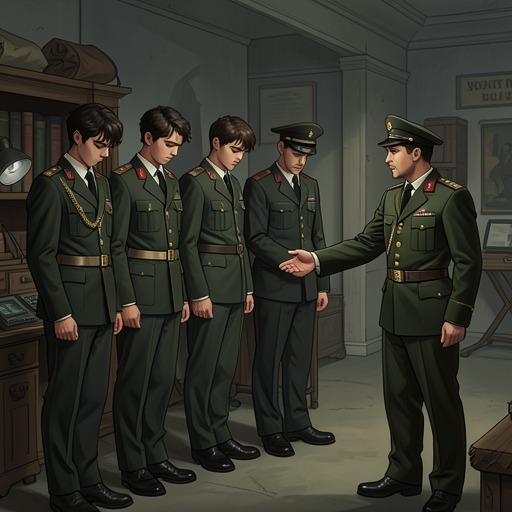
Hitchcock is the first Academy officer to present himself to Landor before the retired investigator’s meeting with Thayer. As Thayer’s second-in-command, he performs the persistent work of supervising the cadets, while Thayer proposes and Hitchcock carries decisions into effect. The account presents him as a necessary point of contact for anyone dealing with the Academy: his position places him between its superintendent and the wider human traffic pressing against the institution. That role makes him a practical gatekeeper, not simply a subordinate who appears when the investigation needs an official voice.
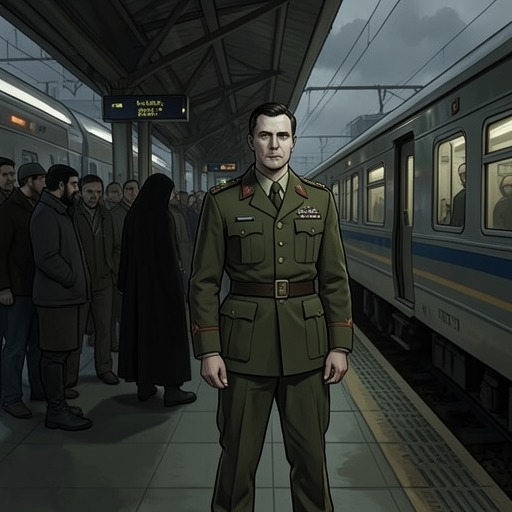
His first appearance is staged in keeping with that intermediate position. Landor initially sees a hand in the light and must infer the rest of the figure; only as Hitchcock approaches does his face and bearing become distinct. He is described as physically striking, with a hard-middled frame, compressed-looking lips, and brown eyes marked by melancholy. Yet the greeting he gives Landor is mild, as if offered by someone visiting a sickbed. The contrast between his stern appearance and gentle tone prevents his authority from reading as simple aggression. He welcomes a retired man whose lungs are a concern, and Landor answers that retirement suits them. The exchange establishes civility between the two without suggesting that their later dealings will be free of pressure.
The Fry Investigation
Hitchcock delivers the blunt central fact that begins Landor’s official involvement: Fry hanged himself the previous night. Landor responds with sympathy, but the investigation soon makes clear that the reported death does not exhaust the case. When Landor examines Fry’s body, he draws attention to the possibility that the missing heart, rather than a person, is the object of the search. Hitchcock answers that his men have canvassed the surrounding grounds and found nothing. The report gives the search a defined extent while also exposing its limit: the officers have covered the nearby grounds, but the central absence remains unexplained.
The exchange is significant because Hitchcock does not dismiss Landor’s question or claim that the search has resolved the matter. He gives the information available to him and leaves the distinction between the apparent suicide and the missing heart open. As Landor develops a theory, Hitchcock identifies its procedural consequence: the inquiry now has to account for both the person who desecrated Fry and the person who killed him. Dr. Marquis suggests that the two mysteries may have one answer. The suggestion does not settle the case, but it alters the terms of the problem. Hitchcock’s challenge makes the multiplication of questions explicit, while the ensuing pause registers that the possibility of a single perpetrator has changed how those present understand the investigation.
Authority, Landor, and the Deadline
Hitchcock’s working relationship with Landor combines cooperation with scrutiny. He supplies the initial report and the result of the search, but he also presses Landor when the investigator refuses to state his theory plainly. For Hitchcock, putting forward a theory implies some degree of belief in it; Landor’s evasiveness therefore has practical costs. Hitchcock tells him that his account has left the authorities with two mysteries where there had been one. This is not merely a demand for a confident answer. It is an insistence that a proposed explanation be measured against the new investigative burden it creates.
Later, Hitchcock appears at Landor’s study still wearing his cloak, his boots rimed with ice. His entrance is abrupt enough to be identified as characteristic of him, but his news concerns institutional responsibility rather than theatrical effect. Thayer and Hitchcock, he says, must both accept responsibility for what will be seen as a failure of judgment in bringing Landor into the case. The chief of engineers is expected to send another investigator, someone authorized to carry the matter through to its end. Hitchcock calculates that the official may arrive in about three days, converting a distant administrative possibility into a fixed term for the investigation. Landor answers that he agreed to take the case and will honor that agreement. Hitchcock accepts the reply without being appeased; his sharpened expression and restless clearing of the desk keep the disagreement visible.
The Final Alert and Narrative Role
Near the conclusion, Hitchcock is again the officer through whom an urgent development reaches Landor. After the events at the icehouse, he calls Landor’s name from above. When asked who raised the alarm, he identifies Cesar. Landor’s retrospective account explains that Cesar, a mess-hall steward, had been assigned to follow Artemus Marquis; after tracking Artemus to the icehouse and seeing Landor and Dr. Marquis follow, Cesar went directly to the commandant. Hitchcock is thus connected to a surveillance effort that becomes consequential at the crisis point, although the account does not say that he personally followed Artemus or discovered what happened inside.
Across these scenes, Hitchcock’s narrative function is to make the Academy’s institutional response legible. He is the officer who supervises the cadets, reports what the search has and has not found, translates a speculative theory into additional investigative obligations, and communicates the limit imposed by outside authority. The narrative first renders him partly in shadow, but his conduct is not left as a mere visual mystery: his statements clarify the chain of command and the pressure surrounding Landor’s work. The available scenes do not resolve the full extent of Hitchcock’s authority or establish a personal transformation. Instead, they show a consistent commandant whose responsibilities bind the case to the Academy’s hierarchy, even as the inquiry threatens to outlast the time that hierarchy can grant.